German (DEU) electronic Product Information Leaflet (ePIL) Implementation Guide - Local Development build (v0.7.0) built by the FHIR (HL7® FHIR® Standard) Build Tools. See the Directory of published versions
Data Structure Overview
This page gives a visual and textual summary of the FHIR resources used to structure an electronic Product Information Leaflet (ePIL) document.
Visual Overview
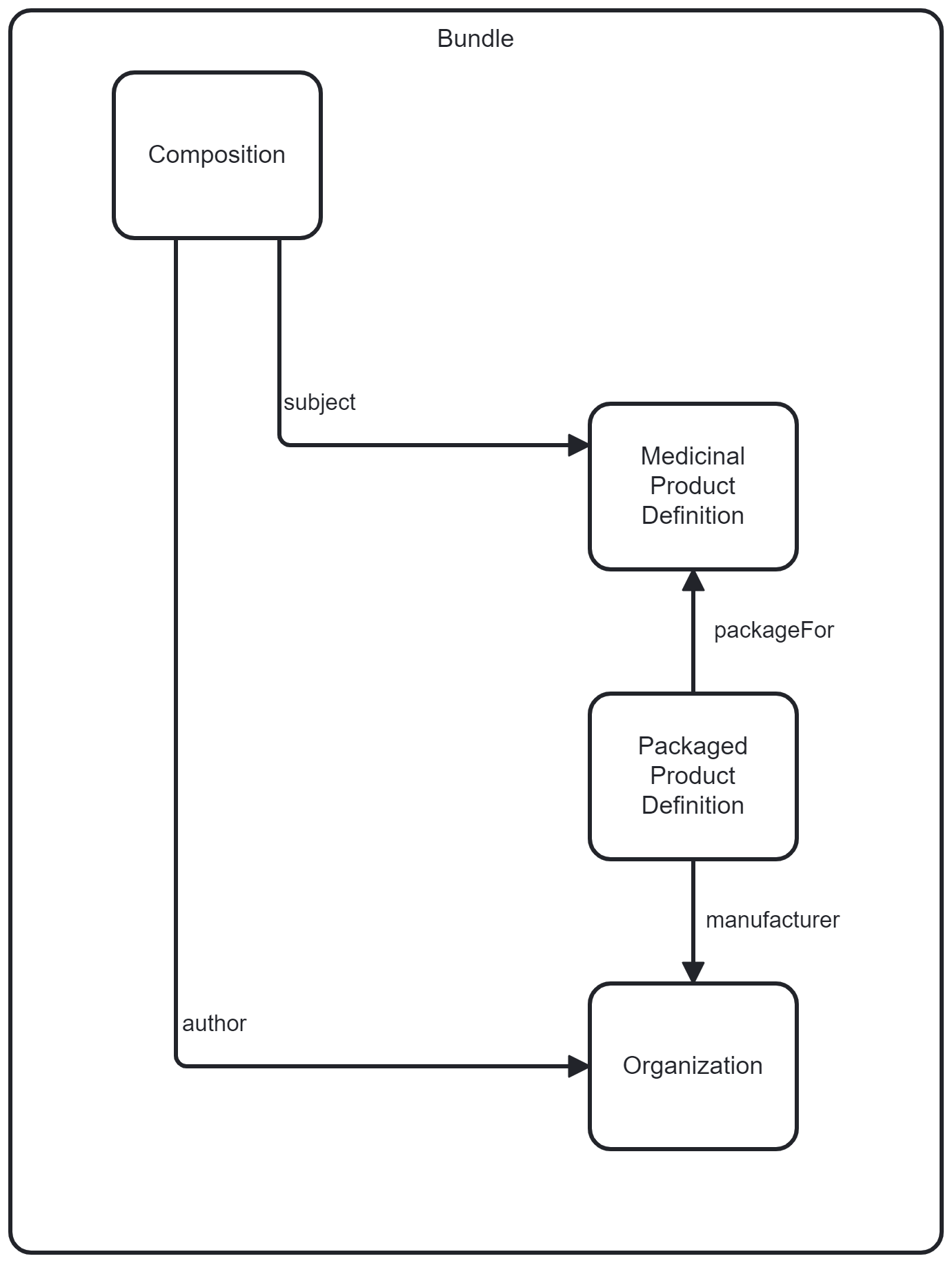
📦 Key Resources
📚 Bundle
A container for all included resources that together form the electronic Package Leaflet. It wraps the entire document and links all related definitions.
🏢 Organisation
Represents an organization involved in the product lifecycle. The Bundle contains 1 or 2 Organization resources, depending on whether the Author and the Marketing Authorisation Holder (MAH) are the same entity. See Author and MAH below for details.
💊 MedicinalProductDefinition
Describes the conceptual product, including its name, identifiers, classification, and pharmaceutical aspects.
📦 PackagedProductDefinition
Defines packaging details, such as physical container types and optional product identifiers (e.g., GTIN, NTIN, PPN, PZN, PCID).
🧾 Composition (Abstract)
Abstract base profile that defines the foundational document structure. Cannot be used directly in instances — serves as parent for the concrete QRD profiles below.
📋 Concrete QRD Profiles
Instances must reference one of the following concrete profiles in meta.profile, depending on the QRD version and API direction:
| Profile | QRD | Direction |
|---|---|---|
| QRD 10.4 eAAPI | 10.4 | Input |
| QRD 10.4 eCAPI | 10.4 | Output |
| QRD 11 eAAPI | 11 | Input |
| QRD 11 eCAPI | 11 | Output |
Each profile enforces required EMA chapters 1-6 and allows optional additional chapters using the diGItal CodeSystem.
This resource model is designed to ensure traceability and structure throughout the ePI lifecycle, while maintaining alignment with regulatory requirements and the HL7 FHIR standard. It leverages base resources and patterns from the Vulcan (Vulcan ePI IG) and EMA (EMA ePI IG) implementation guides, but further details and adapts them for the specific requirements of the diGItal project context and digital pilot use case.
Author and MAH
The FHIR Bundle carries two distinct organizational roles that must both be identified in the Composition:
Author — The organization that created and submitted the ePIL document. Referenced in Composition.author. This may be the MAH itself or a subcompany acting on behalf of the MAH.
Marketing Authorisation Holder (MAH) — The organization holding the marketing authorisation for the medicinal product. Referenced in the Composition via a dedicated MAH extension.
Bundle Organization Resources
The Bundle contains 1 or 2 Organization resources depending on whether the Author and MAH are the same entity:
| Scenario | Organization resources in Bundle | Composition references |
|---|---|---|
| Author = MAH (same ORG-ID) | 1 Organization | author and MAH extension both reference the same Organization |
| Author ≠ MAH (different ORG-IDs) | 2 Organizations | author references the Author Organization, MAH extension references the MAH Organization |
Both references — Composition.author and the MAH extension — are mandatory. A submission without the MAH extension will be rejected.
Examples
Author ≠ MAH (two Organization resources in Bundle):
<Composition>
    <!-- MAH Extension (must appear before author in FHIR XML) -->
    <extension url="http://fhir.pharmaprotect.de/digital/epil-fhir-ig/StructureDefinition/DEU-ePIL-MAH-Organization">
        <valueReference>
            <reference value="urn:uuid:mah-org-uuid"/>
        </valueReference>
    </extension>

    <!-- Author -->
    <author>
        <reference value="urn:uuid:22f7bae3-50ca-4876-a2ee-4e7a4b4616df"/>
    </author>
</Composition>
Author = MAH (one Organization resource, both references point to it):
<Composition>
    <!-- MAH Extension (same reference as author) -->
    <extension url="http://fhir.pharmaprotect.de/digital/epil-fhir-ig/StructureDefinition/DEU-ePIL-MAH-Organization">
        <valueReference>
            <reference value="urn:uuid:22f7bae3-50ca-4876-a2ee-4e7a4b4616df"/>
        </valueReference>
    </extension>

    <!-- Author -->
    <author>
        <reference value="urn:uuid:22f7bae3-50ca-4876-a2ee-4e7a4b4616df"/>
    </author>
</Composition>
Document Identification and Versioning
The ePIL document model uses two distinct identifiers to support version management:
Bundle.identifier — Document Identity
The Bundle.identifier is a persistent business identifier that remains the same across all versions of a single ePIL document. It uniquely identifies the logical document (i.e., "the package leaflet for product X") regardless of how many revisions are published.
- Cardinality: 1..1 (mandatory)
- Persistence: Must not change between versions — all revisions of the same ePIL share this identifier
- Format: UUID recommended
- Identifier system: The
identifier.systemis a customer-specific URI that defines the namespace in which the identifier value is unique (per FHIR standard)
Composition.identifier — Version Identity
The Composition.identifier is a version-specific identifier that uniquely identifies a particular revision of the ePIL content. Each time the ePIL is updated and a new version is published, a new Composition.identifier must be assigned.
- Cardinality: 1..1 (mandatory)
- Uniqueness: Must be different for each version of the document
- Format: UUID recommended
- Identifier system: The
identifier.systemis a customer-specific URI that defines the namespace in which the identifier value is unique (per FHIR standard)
Identifier Relationship
| Identifier | Scope | Changes between versions? | Purpose |
|---|---|---|---|
Bundle.identifier |
Document (all versions) | No — remains the same | Identify which ePIL this is |
Composition.identifier |
Single version | Yes — new value per version | Identify which version of the ePIL |
Example
Version 1 of an ePIL:
<Bundle>
    <identifier>
        <system value="urn:ietf:rfc:3986"/>
        <value value="urn:uuid:abcd1234-5678-90ab-cdef-1234567890ab"/>
    </identifier>
    <!-- ... -->
    <Composition>
        <identifier>
            <system value="https://example-pharma.com/epil-ids"/>
            <value value="urn:uuid:1111-aaaa-2222-bbbb"/>
        </identifier>
        <version value="1.0.0"/>
    </Composition>
</Bundle>
Version 2 of the same ePIL (same Bundle.identifier, new Composition.identifier):
<Bundle>
    <identifier>
        <system value="urn:ietf:rfc:3986"/>
        <value value="urn:uuid:abcd1234-5678-90ab-cdef-1234567890ab"/>
    </identifier>
    <!-- ... -->
    <Composition>
        <identifier>
            <system value="https://example-pharma.com/epil-ids"/>
            <value value="urn:uuid:3333-cccc-4444-dddd"/>
        </identifier>
        <version value="2.0.0"/>
    </Composition>
</Bundle>